How to Choose a Pool Cover Reel: Specification Guide
Select a pool cover reel by the exact cover, supported span, tube configuration, placement, operation, attachment method, and manufacturer-rated capacity.
Key takeaway
Select a pool cover reel by the exact cover, supported span, tube configuration, placement, operation, attachment method, and manufacturer-rated capacity.
A pool cover reel should be selected for the exact cover and site—not from pool width alone. Confirm the reel model, supported tube, rated cover dimensions or load, placement, attachment system, mobility, operating method, and storage arrangement as one setup.
Quick answer
Start with the finished cover rather than the reel photograph. Record its actual width, length, construction, mass when available, number of sections, and attachment details. Then compare those facts with the current instructions and capacity table for the exact reel-and-tube combination.
Do not assume that a larger tube diameter, a “commercial” label, or a stated maximum pool width independently proves compatibility. Manufacturer examples show that capacity can change with the selected tube, cover thickness, cover width and length, reel configuration, and operating method.
1. Define the cover before sizing the reel
The reel stores and moves a finished cover, so the first specification package should describe that cover accurately:
- cover type and intended use;
- finished width and length of each section;
- material construction and nominal thickness;
- mass per square metre and total dry mass, when documented;
- edge, seam, reinforcement, strap, eyelet, or clip details;
- expected rolled diameter, if supplied by the cover or reel manufacturer;
- whether the cover is already manufactured or will be made for the reel system.
Pool dimensions remain important, but they are not always identical to finished cover dimensions. Steps, Roman ends, islands, ladders, rails, lane equipment, overflow details, and intentional sectioning can change the cover geometry and winding plan.
2. Use the exact manufacturer’s capacity—not a generic rule
Capacity is product-specific. For example, Rocky’s lists one portable reel with two different compatible tubes: its AT-1 configuration is listed for pools up to 20 ft wide, while its AT-2 configuration is listed up to 24 ft wide. The same table limits the example to covers up to 45 ft long at 12 mil and notes that capacity is width-dependent.
AstralPool gives a different type of rating for a 100 mm telescopic roller: one product code is listed for pools up to 10 × 5 m and another for up to 12 × 6 m. Daisy’s current roller specification sheet likewise assigns different maximum pool sizes to specific models and tube constructions.
These examples do not establish an industry-wide capacity for a 75, 80, 100, or 125 mm tube. They demonstrate why the model, tube construction, supported span, cover construction, and manufacturer’s current capacity table must remain connected.
3. Distinguish pool width, cover width, tube length, and supported span
These measurements answer different questions:
- Pool width: the relevant pool or water-surface dimension at the proposed reel location.
- Cover width: the finished material dimension that will wind onto the tube.
- Tube length: the overall assembled tube dimension.
- Supported or working span: the distance/configuration the manufacturer permits between the reel supports.
- Clearance: the space needed for stands, handles, wheels, motors, brakes, coping, and safe operation.
Daisy’s installation guide, for example, instructs users of its listed systems to prepare the tube approximately 300 mm wider than the main cover area. That is a Daisy product instruction, not a universal allowance. Use the dimension specified for the selected reel rather than copying 300 mm into another system.
4. Tube diameter alone does not determine stiffness or capacity
Tube behaviour also depends on material, wall thickness, cross-section, telescopic overlap, joints, unsupported span, load distribution, and manufacturing design. Two tubes with the same outside diameter can therefore have different permitted spans and cover capacities.
Ask for the exact tube code and configuration, not only its nominal diameter. Where the supplier publishes a maximum span, cover size, or load, keep that limit attached to the named reel and tube. Do not calculate a higher capacity by extrapolating from a shorter span or another brand’s tube.
Visible sag, unstable supports, binding, or uneven winding should not be accepted as normal. Stop operation and have the setup checked against the manufacturer’s assembly and capacity instructions.
5. Plan the reel position around the pool geometry
A rectangular cover can often wind from one end, but irregular shapes may require a different reel position, a fold, multiple cover sections, or a manufacturer-approved attachment layout. Rocky’s publishes different placement instructions for regular, round, oval, Roman-end, kidney, and other irregular covers, which illustrates that shape affects more than the cover cutting pattern.
Record:
- proposed reel location and winding direction;
- distance from the water and height relative to the coping;
- ladders, handrails, starting blocks, walls, columns, channels, and water features;
- deck slope, surface construction, drainage, and access routes;
- the space required to operate, move, brake, anchor, or store the reel;
- whether a divided cover would be easier to control than one large section.
Do not position a reel where it obstructs required circulation or emergency access. Site and code requirements must be reviewed by the responsible facility or project professional.
6. Match fixed, mobile, wall-mounted, or powered operation to the workflow
The appropriate configuration depends on the site, cover, and operating routine.
Fixed reels need a verified mounting surface and the correct manufacturer-specified anchors. Mobile reels need sufficient level deck space, controllable movement, and a defined storage position. Wall- or bench-mounted systems require structure, clearances, and installation details designed for that load. Powered reels add electrical, control, emergency-stop, access, and maintenance requirements.
Commercial instructions can be more restrictive than residential practice. S.R.Smith’s T30 manual, for example, requires its floor brakes to be applied while covers are removed, stored, or deployed, requires at least two people to move that reel, and prohibits those operations on a sloped surface. Those are requirements for the named system; the selected reel’s own manual must control.
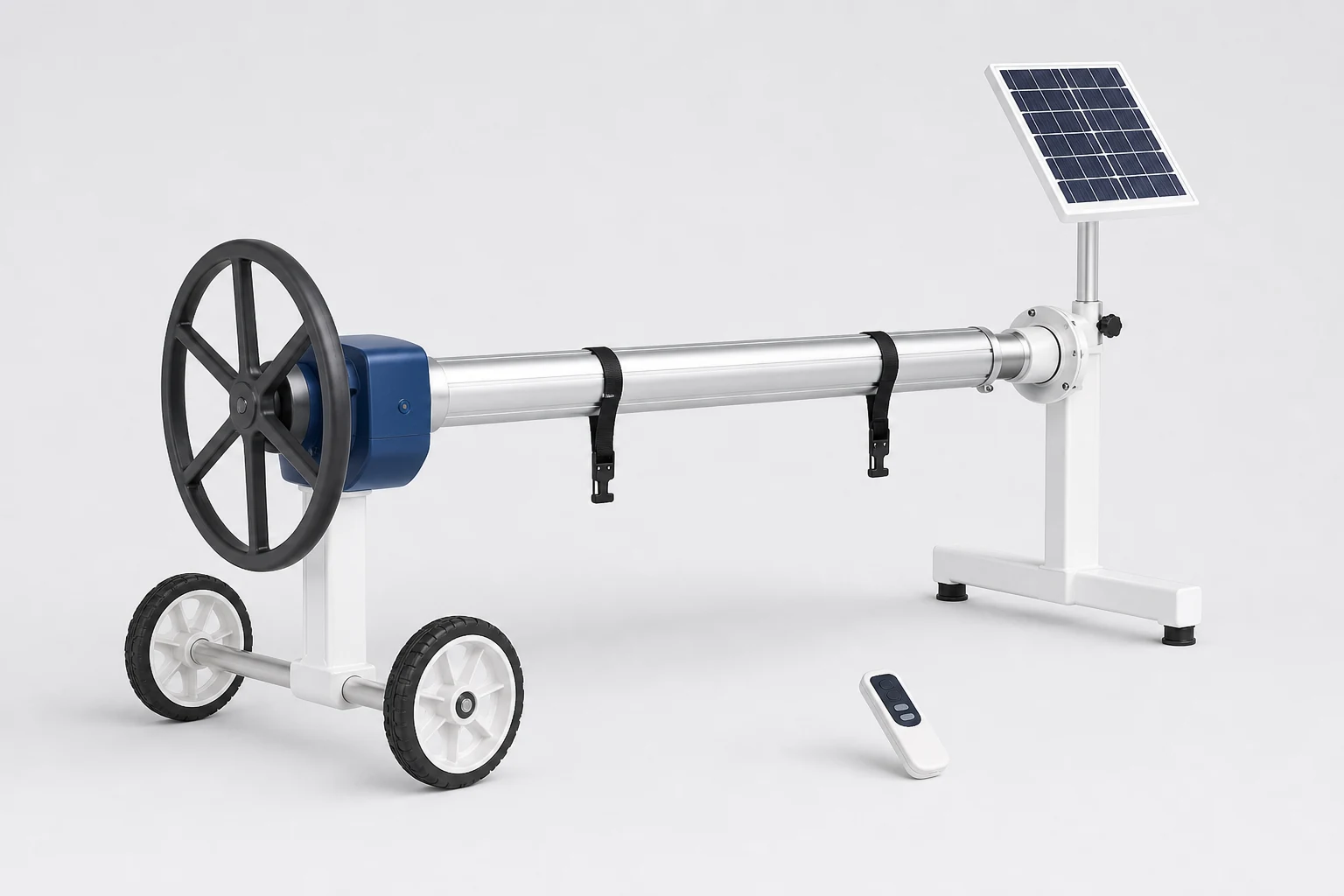
For powered equipment, obtain the electrical rating, environmental protection information, control method, emergency or manual procedure, and installation requirements. Do not infer those details from a photograph, solar panel, remote, or motor label.
7. Confirm the attachment system and winding alignment
The cover-to-reel connection may use straps, cords, clips, eyelets, grommets, or a proprietary leading-edge arrangement. Use the specified parts, positions, spacing, and cover preparation for the exact system.
Alignment matters. Rocky’s troubleshooting guidance identifies a reel that is not square to the pool and straps with unequal tension as causes of bunching and creasing. A practical commissioning check should therefore confirm that:
- the reel is positioned as required by its instructions;
- attachment points are correctly distributed;
- straps or cords have the specified and consistent length/tension;
- the cover enters the reel evenly without catching an obstacle;
- edges and folds do not build an uncontrolled cone-shaped roll;
- the operator stops if resistance or misalignment develops.
Do not drill, cut, fold, reinforce, or add attachment points until the cover and reel instructions have been reconciled. An improvised connection can damage the cover or change how load reaches the tube.
8. Treat operator count and technique as specification fields
“Manual” does not mean that every cover can be handled safely by one person. Operator requirements depend on cover size, sectioning, reel design, pull direction, deck conditions, and the manufacturer’s procedure.
S.R.Smith’s manual reel instructions give one commercial example: brakes are locked before deployment, one person walks the lead line, and another controls the reel so resistance does not cause excessive dragging force. Its powered wall-reel manual requires the operator to maintain visual contact and use the stop control if a problem occurs.
For the selected system, document who will operate it, how the cover is guided, when additional staff are required, and where the operator must stand. Train staff from the supplied manual rather than from a generic video for another product.
9. Include storage and cover protection
The reel is also a storage device. Confirm the rolled-cover diameter, clearance from walls and equipment, protection from traffic and impact, and the cover manufacturer’s requirements for heat, sunlight, cleaning, drying, and long-term storage.
A floating solar cover can overheat while rolled or folded away from the cooling effect of the water. Use the compatible protective over-cover or storage method required for the selected cover. The solar pool cover care guide explains the broader handling precautions without transferring another brand’s warranty conditions to Avenqua products.
10. Safety boundaries
A reel does not convert a floating solar or thermal cover into a safety cover. Remove the cover completely before anyone enters the pool. Do not walk, sit, stand, or play on it, and do not allow anyone beneath it. The U.S. Consumer Product Safety Commission warns about entrapment and drowning beneath solar pool covers; S.R.Smith’s thermal-cover manuals carry the same essential warning.
Keep people clear of the winding path, tube, handles, wheels, attachment cords, and other moving or pinch areas during operation. Apply brakes, locks, anchors, guards, and emergency procedures exactly as required for the selected equipment. A powered reel should be installed and serviced only under its instructions and applicable electrical/site rules.
11. Pool cover reel RFQ checklist
Send these fields with the broader pool product RFQ checklist:
- Pool type, location, and indoor/outdoor environment.
- Pool plan with water-surface dimensions and proposed reel location.
- Finished cover width, length, number of sections, construction, and thickness.
- Documented mass per square metre, total mass, or rolled diameter when available.
- Obstacles, deck clearances, deck slope, surface, and storage route.
- Fixed, mobile, wall-mounted, bench-mounted, manual, or powered preference.
- Tube code, supported span, and manufacturer-rated capacity required.
- Stand, wheel, brake, anchor, bearing, handle, motor, and control configuration.
- Attachment kit and required cover preparation.
- Intended operator count and frequency of use.
- Electrical supply and controls where powered operation is considered.
- Quantity, packing, destination, installation documents, and spare-parts requirements.
- Items that remain to be confirmed before approval.
For an Avenqua enquiry, send the cover specification and a dimensioned pool/deck plan where possible. The exact offered model and current specifications must be confirmed in the quotation; this guide does not replace that model documentation.
Frequently asked questions
Can I select a reel from pool width alone?
No. Width is necessary, but the exact cover dimensions and construction, tube/reel capacity, placement, attachment method, clearance, operation, and storage also need review.
Does a larger tube always support a larger cover?
Not as a universal rule. Diameter is only one part of tube design. Compare the named tube’s material, wall, joints or telescopic construction, permitted span, and published capacity.
Can one large irregular cover use a standard end reel?
Sometimes, but not automatically. The manufacturer may require a different reel location, approved folds or attachments, or multiple cover sections. Submit a plan and photographs before deciding.
Is a mobile reel safe to operate without locking it?
Follow the exact manual. Commercial instructions commonly require brakes or anchoring during operation, but the hardware and procedure vary. Do not assume that a wheel brake replaces any specified anchor or stabilizer.
Can a powered reel be chosen only by cover weight?
No. Confirm the complete reel, tube, motor/drive, controls, duty, cover geometry, attachment, structure, electrical supply, environmental conditions, and operating procedure.
Are the third-party capacities in this guide Avenqua specifications?
No. They are examples showing how established manufacturers define capacity differently. Avenqua specifications must come from the exact model documentation and quotation supplied for the project.
Primary technical references
- AstralPool: telescopic roller product data and model capacities
- Daisy Pool Covers: pool roller installation guide
- Daisy Pool Covers: current pool roller specification sheet
- Rocky’s Reel Systems: 3A reel and tube capacity table
- Rocky’s Reel Systems: installation guidance for different pool shapes
- Rocky’s Reel Systems: winding alignment and strap troubleshooting
- S.R.Smith: T30 commercial storage-reel assembly and operating requirements
- S.R.Smith: manual storage-reel operating instructions
- S.R.Smith: powered wall-reel installation and operation manual
- U.S. CPSC: drowning hazard warning for solar pool covers