Hotel and Resort Pool Cover Planning: Comfort, Cleanliness, and Energy Savings
Pool cover selection can support guest comfort while helping operators manage water, heat, and cleaning routines.
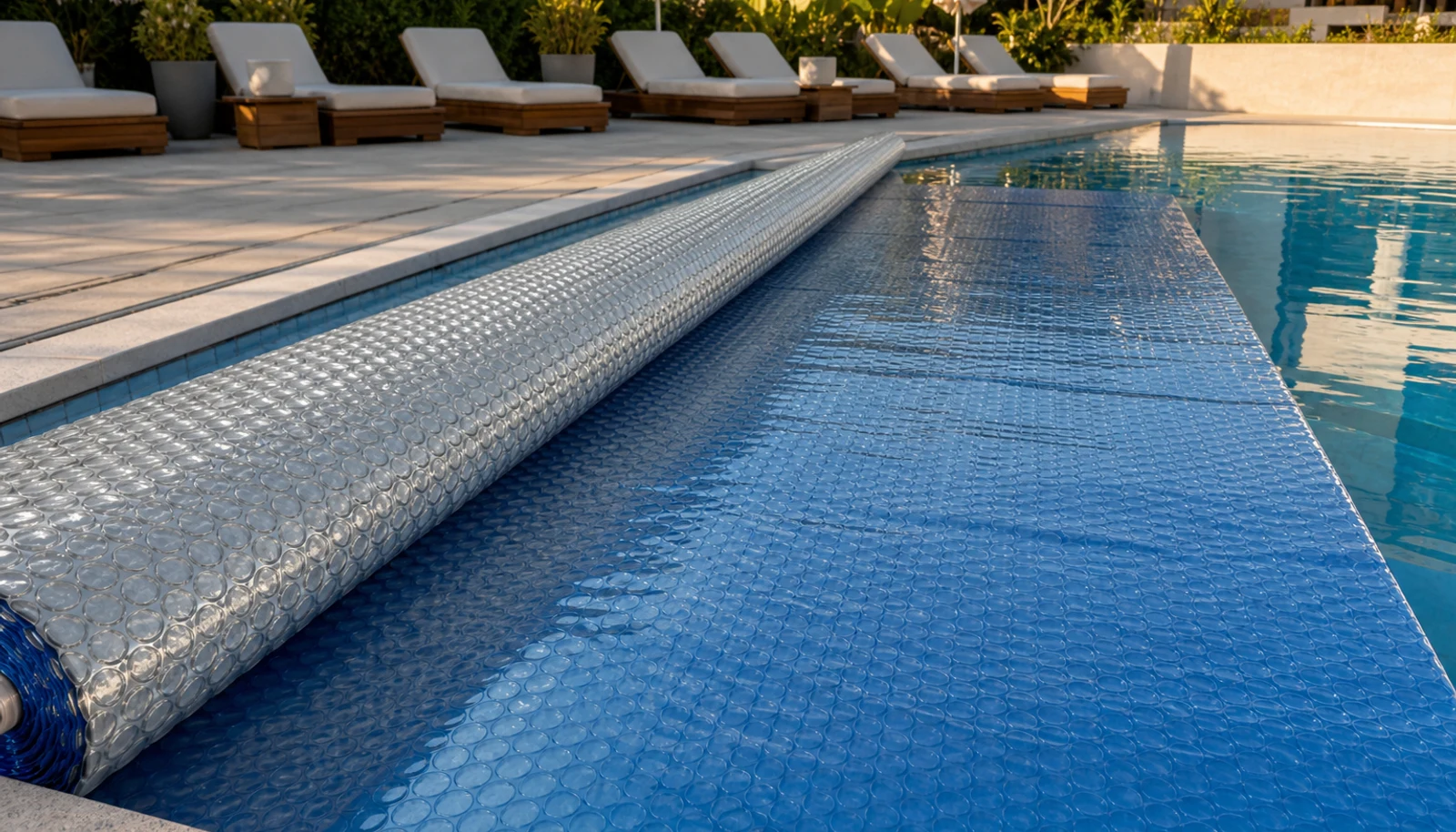
Key takeaway
Pool cover selection can support guest comfort while helping operators manage water, heat, and cleaning routines.
Hotels and resorts manage pools as guest amenities, regulated aquatic venues, and significant operating assets. A cover can reduce evaporation and help retain heat when the pool is closed, but the best system is the one staff can deploy safely and consistently within the operating schedule.
The U.S. Environmental Protection Agency (EPA) identifies covering a pool as the most effective way to reduce evaporation. Its commercial-pool guidance estimates that solar and bubble covers can reduce evaporation by 50% to 95% while in use, depending on shape and surface coverage. Actual water, chemical, and heating savings vary with climate, wind, water temperature, opening hours, cover fit, and how often staff use it.
Define the job before choosing the cover
Start with the operating objective:
- Evaporation and heat retention: a floating bubble or thermal cover may suit closed hours when no swimmer access is allowed.
- Routine debris control: cover design and handling need to match the site’s wind, landscaping, and cleaning plan.
- Seasonal closure: a winter cover is designed for longer closure periods and has different anchoring and handling requirements.
- Restricted access and safety: use only a purpose-designed safety-cover system that meets the applicable standard and local requirements.
These categories are not interchangeable. A solar bubble cover is not a safety cover.
Measure more than the water surface
Record the pool length, width, shape, steps, raised walls, islands, ladders, rails, overflow channels, and any features that prevent a straight pull. Then map the deck space required for a roller or automatic-cover housing.
Check access routes and storage. Staff should be able to move, deploy, remove, and protect the cover without dragging it over rough edges or blocking emergency routes. Large or irregular pools may need multiple cover sections, more than one roller, or a different system altogether.
Build the cover into daily operations
EPA guidance emphasizes using a cover as often as possible because performance depends on actual coverage time. Before purchasing, write a trial procedure answering:
- Who is authorized and trained to operate the cover?
- At what time is it installed and fully removed?
- How is the pool checked before opening?
- Where is the cover stored and protected?
- How are debris, rainwater, damage, and chemical-treatment periods handled?
- What happens during high wind or severe weather?
A system that requires more staff or time than the property can reliably provide is unlikely to deliver its modeled savings.
Keep safety categories explicit
The U.S. Consumer Product Safety Commission warns that swimmers should never enter a pool that is partially covered by a solar cover because a person can become trapped beneath it. A floating bubble cover must be completely removed before the pool opens.
In the United States, ASTM F1346 establishes performance and labeling requirements for products represented as safety covers. The standard is intended to reduce access by children under five when a compliant cover is correctly installed and used. A safety cover is still one layer in a broader protection plan; supervision, barriers, gates, alarms, operating procedures, and local code remain important.
Estimate savings conservatively
Avoid quoting a universal payback period. Establish a baseline using water-meter data, heating-energy use, make-up water, chemical use, pool temperature, weather, and open hours. Then model expected covered hours and measure actual results after installation.
For an outdoor pool, wind exposure can materially affect evaporation. Screens, walls, and appropriate landscaping may complement the cover, provided they do not create visibility, access, or debris problems.
Procurement checklist for hotels and resorts
- Confirm the primary objective and whether a safety-rated system is required.
- Survey pool geometry, deck space, storage, and access routes.
- Check compatibility with water treatment and operating temperatures.
- Request installation, operation, cleaning, storage, and warranty documents.
- Confirm staffing and deployment time for every operating day.
- Identify the applicable pool code and safety-cover standard.
- Plan inspection records, spare parts, and preventive maintenance.
- Measure performance against a real pre-installation baseline.
Frequently asked questions
How much evaporation can a solar bubble cover prevent?
EPA commercial guidance gives a range of 50% to 95% while the cover is in use, depending on its shape and coverage. A project’s annual result depends heavily on how completely and consistently the pool is covered.
Can guests swim while part of a solar cover remains on the pool?
No. The cover should be completely removed before anyone enters. CPSC has specifically warned about entrapment and drowning beneath partially deployed solar covers.
Is the thickest bubble cover always the best option?
No. Thickness is only one factor. Material formulation, cover design, fit, handling system, water compatibility, climate, warranty, staff workload, and intended objective all matter.