Why Geotextile Felt Underlay Matters for PVC Pool Liner Installation
Avenqua explains how geotextile felt underlay supports smoother liner installation and better project handling.
Key takeaway
Avenqua explains how geotextile felt underlay supports smoother liner installation and better project handling.
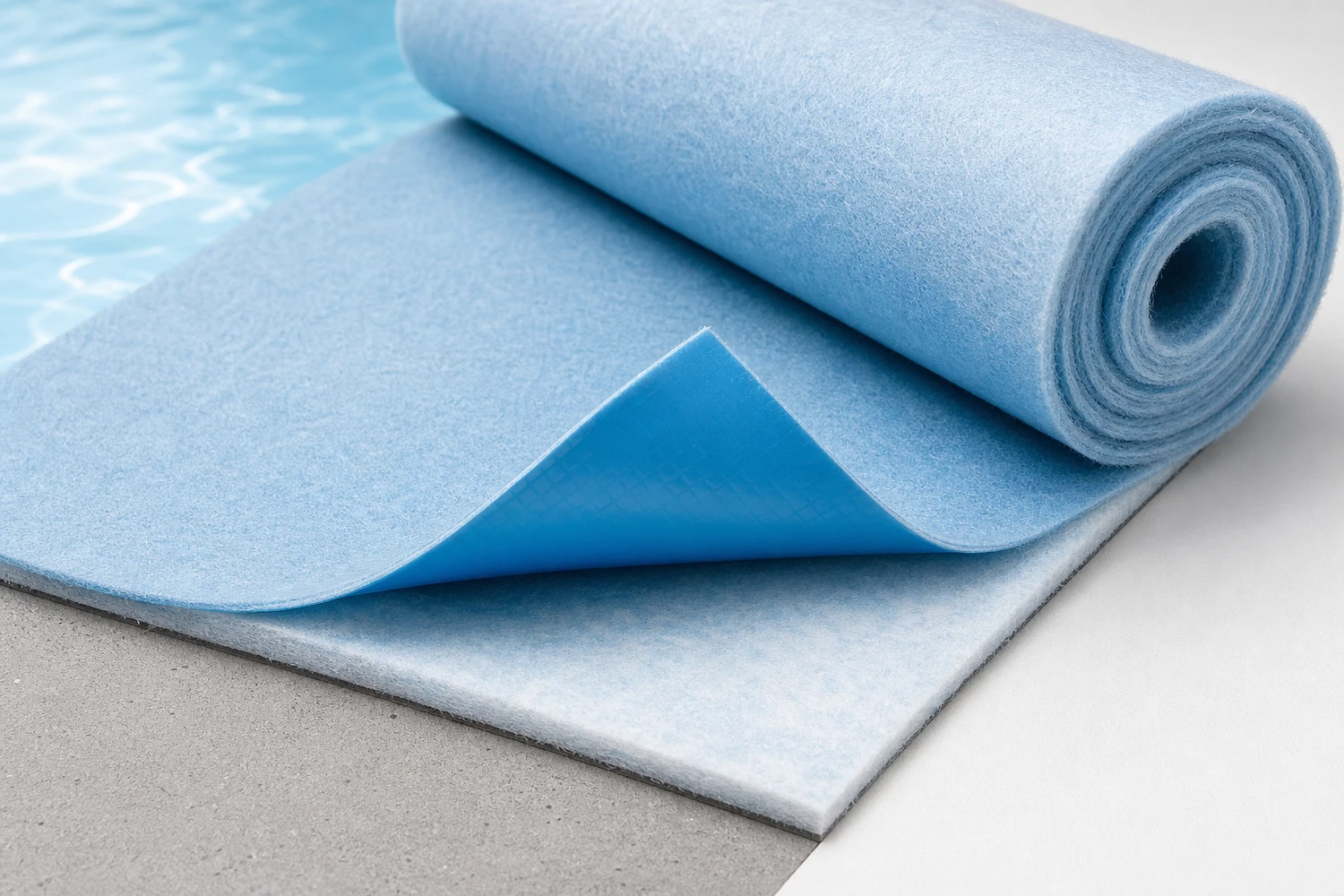
Geotextile felt underlay is a separator and cushioning layer used beneath some reinforced PVC pool-membrane systems. It can reduce direct contact between the membrane and a compatible substrate, soften the feel underfoot, and limit the visual transfer of minor surface texture.
It is not automatically required for every liner, and it is not interchangeable across every system. The membrane manufacturer’s installation specification should control the material, weight, treatment, adhesive, joint layout, and locations where underlay is permitted.
What pool liner underlay can do
On a properly prepared substrate, a compatible geotextile can:
- provide cushioning beneath the finished membrane;
- separate the membrane from minor substrate roughness;
- reduce the appearance of small, stable surface imperfections;
- provide a uniform working layer for membrane installation;
- protect the back of the membrane from direct contact with a compatible but abrasive base.
Manufacturer systems vary. For example, RENOLIT’s current professional catalogue identifies a specific polypropylene geotextile product for use between its reinforced membrane and pool shell. That does not mean any generic landscape or drainage geotextile is suitable for a swimming-pool membrane.
What underlay cannot do
Geotextile felt is not a substitute for structural repair, substrate waterproofing where separately required, or correct membrane welding. It cannot stabilize a moving crack, correct an out-of-level shell, remove moisture, or compensate for sharp projections and loose material.
The substrate still needs to be sound, clean, smooth enough for the specified system, and free from conditions that could damage or contaminate the membrane. Active leaks, structural movement, corrosion, hollow render, sharp edges, incompatible coatings, and biological contamination should be investigated before installation.
Use a pool-system product, not a generic felt
Compare the proposed underlay against the membrane-system instructions. Confirm:
- fiber material and nominal mass or thickness;
- compatibility with the pool shell and membrane;
- whether antimicrobial or fungicidal treatment is specified;
- permitted adhesive and application method;
- joint treatment and whether overlaps are allowed;
- use on floors, walls, steps, corners, and fittings;
- resistance to the expected installation and operating conditions.
A treated underlay can be one part of a system intended to reduce microorganism growth behind the membrane, but the treatment and claim are product-specific. Do not describe an untreated generic felt as antimicrobial.
Prepare the substrate before measuring rolls
Inspect the empty pool and mark repairs before calculating the underlay quantity. Measure floors, walls, slopes, steps, benches, and other covered surfaces separately. Add only the allowance required by the selected joint layout and manufacturer instructions.
Plan seams so they do not create visible ridges beneath the membrane. Keep adhesive out of membrane-welding zones and use only system-approved products. Around drains, inlets, lights, and other penetrations, follow the membrane supplier’s detail rather than improvising a felt overlap.
Installation sequence
A typical project sequence is:
- Confirm the pool structure and substrate are suitable.
- Complete repairs, cleaning, drying, and any specified disinfection.
- Verify fittings and termination components.
- Install the specified geotextile without wrinkles or debris beneath it.
- Trim and bond joints as the system requires.
- Install and weld the reinforced membrane.
- Inspect the finished surface and test seams using the installer’s approved procedure.
- Fill and commission the pool according to the membrane manufacturer’s instructions.
The exact sequence can differ by system. Manufacturer details and local project requirements take precedence.
Frequently asked questions
Does felt underlay waterproof a swimming pool?
No. In a reinforced PVC system, the membrane provides the waterproof finish. Underlay is a supporting separator or cushioning layer.
Can underlay hide cracks?
It may reduce the visual transfer of small, stable texture, but it cannot repair or stabilize a structural or moving crack.
Can landscaping geotextile be used under a pool liner?
Not without written confirmation from the membrane-system supplier. Pool underlay needs verified compatibility, suitable construction, and the installation properties required by the selected system.
Should geotextile seams overlap?
There is no universal rule. Some systems require butt joints or other specific detailing to avoid showing through the membrane. Follow the selected manufacturer’s instructions.